


From a Single Chain to a Full System: How ENI Is Moving Toward Becoming the "Oracle” of Web3
- 香港卫视网
- 2026-04-14 15:53:52
-
 收藏
收藏
Over the past few years, competition in the public blockchain market has largely centered on performance, ecosystem growth, and liquidity. As a result, this phase has been defined by the pursuit of higher efficiency, lower costs, and greater scalability. But as Web3 begins to move into large-scale commercial adoption, enterprise priorities are starting to shift. What enterprises care about is no longer just whether a chain is fast enough, but also whether the architecture can support high-frequency business operations, accommodate complex organizational structures, and remain stable, coordinated, and resilient through continued scale. What ENI aims to address is no longer just the technical question of on-chain execution efficiency, but the full spectrum of commercial demands enterprises face as they move into Web3.
From Single-Chain Capability to System Architecture
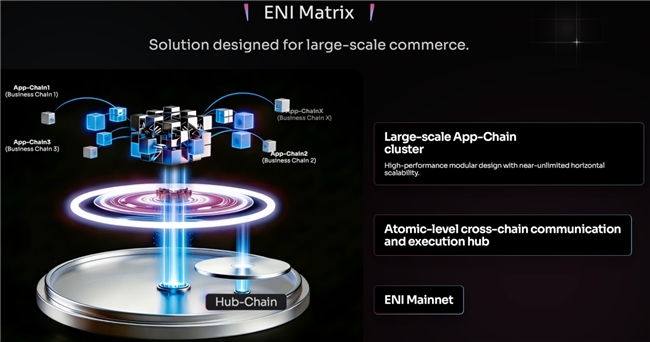
ENI’s focus is to build, on top of its existing high-performance foundation, an architectural model that is better aligned with enterprise needs. ENI adopts a modular architecture centered on the ENI Mainnet, Hub-Chain, and App-Chain, using that structure to organize connectivity, coordination, and scalability across enterprise-grade scenarios.
This architecture is designed to map more naturally onto real-world commercial deployment. The mainnet provides a unified base layer, the Hub-Chain is responsible for inter-chain connectivity and coordination, and AppChains can be deployed flexibly around different business scenarios. High performance, modular design, Custom BaaS, frictionless integration, and one-click chain deployment are brought together into an implementation path that is better suited to enterprise onboarding and scale-out.
For Large Enterprises: Supporting Complex Business Operations
For large enterprises and institutional clients, what they truly need is rarely a standardized on-chain tool. More often, they need an operating framework that can be embedded into the complexity of their business architecture and organizational structure. The chain itself is not the goal. The real objective is to integrate into core workflows, support mission-critical operations, and provide a foundation for long-term expansion.
Viewed in that context, ENI is clearly not built around the logic of a lightweight point solution. It is much closer to a platform-oriented configuration: the mainnet serves as the stable foundation, the Hub-Chain handles coordination and connectivity, and AppChains preserve relatively independent operating environments for different business structures. Modular deployment, customized services, and an architectural logic built around enterprise use cases all converge on the same question: how to bring Web3 into complex commercial environments in a meaningful way, rather than leaving it at the level of a purely technical demonstration.
For SMEs: Lowering the Barrier to Deployment
Unlike large enterprises, SMEs do not necessarily lack Web3 use cases. What tends to hold them back is the cost of deployment, the integration path, and the complexity of implementation. Whether it is data notarization, supply-chain traceability, brand provenance, or digital operations, these can all represent real business needs. But if the implementation burden is too heavy and the path to deployment too long, even clearly defined demand can struggle to translate into real adoption.
What ENI is trying to solve for this segment, therefore, is not a question of capability level, but of how to enable businesses to enter Web3 with less friction. Frictionless integration, one-click chain deployment, and more flexible BaaS models are all aimed at shortening the path to adoption, allowing businesses to embed Web3 capabilities more naturally into their existing workflows without taking on an overly burdensome systems overhaul.
Toward Becoming the “Oracle” of Web3
For ENI, moving toward becoming the “Oracle” of Web3 is not just an aspirational line. It is also a way of defining the role it wants to play. What ENI is trying to convey is its ambition to become a more central infrastructure layer as large-scale commercial adoption begins to unfold: one that not only supports current business deployments, but also creates room for future expansion, coordination, and value creation.
From a single chain to a full system, what ENI is trying to achieve is not just an extension of product form, but a clearer definition of its own role. Once Web3 truly enters the stage of large-scale commercial adoption, what the market will need is no longer just infrastructure with stronger specs, but key platforms that can absorb demand, connect real-world scenarios, and support the ongoing operation of commercial networks. That is the role ENI is aiming to become.
相关推荐
加密原生高管入选《财富》最具影响力女性,奠定行业里程碑地位
推荐 2026-06-03 09:37:20AI+教育 | 現代物流集團AI培訓進行時
推荐 2026-06-02 13:22:33開元雲受邀出席2026世界智能大會
推荐 2026-06-02 12:59:09Anthropic估值近万亿凸显AI平台需求高涨,FNXI助力相愛冲刺纳斯达克上市
推荐 2026-06-02 09:49:43扎根香港 布局全球 引領醫療科創 元化智能进驻香港港深创科园
推荐 2026-05-28 14:28:51热门资讯 日 周 总
双院长做客武汉美莱《时尚气质微整颜究所》 拆解童颜抗衰与 T 区精雕美学密码
节目 2026-05-25香港優才及專才協會辦「資優教育論壇」 聚焦資優教育新趨勢,攜手共育未來棟樑
节目 2026-05-25宁德海博特医与一棵茶股份三大里程碑引领茶叶籽二酯油产业高质量发展
节目 2026-05-22盛会圆满收官 聚力行业升级 —— 第三十三届中国国际乐器展览会助力行业高质量发展
节目 2026-05-20智匯齊魯 元啟未來|AI 智慧體智造基地正式啟動
节目 2026-05-19电子签名新规落地!3分钟自查,你用的电子签名合规吗?
节目 2026-05-19開元雲榮膺 2026 福布斯中國人工智慧商業落地示範企業
节目 2026-05-18世界级研发验证试验室启用,中国汽研中汽院(浙江)公司正式开业
节目 2026-05-18中美高层握手,香港Space-CNX如何抢占万亿蓝海?
节目 2026-05-18北京国际乐器展盛大启幕 国乐西乐交融绽放乐器文化新魅力
节目 2026-05-15AW2026童博会·上海少儿时尚周--全球品牌形象推广大使刘若涵
节目 2026-05-15星域破局者:Space-CNX崛起香港,卡位太空能源与低轨经济
节目 2026-05-13雁江"护苗”记:一场关于178个孩子的守护实验
节目 2026-05-07泡饭POP FRIENDS东莞首店,探索潮玩新体验
节目 2026-05-06第四屆"一帶一路”綠色發展故事短影片大賽全球徵稿啟動 以鏡頭為媒傳遞綠色絲路力量
节目 2026-04-29- 深圳礼品展惊现"神展位”!东菱、Glasslock盖朗、CLARA克拉拉等四大品牌合体,玻璃相关产品要成下一个风口?2026-04-28
- 悦己疗愈,美由心生|武汉医生营养师社群首场身心美学沙龙圆满举行2026-04-28
- 独牙传奇,相拥山海!"仙剑奇侠”赵剑波狂揽200万加冕中式九球新王2026-04-27
- 从非遗出海到AI智造:第34届深圳礼品家居展首日爆棚,见证中国礼业生态跃迁2026-04-25
- WPS表格高级数据处理与动态报表技巧2026-04-24
- SafeW 如何在 Kubernetes 集群中实现数据主权隔离2026-04-23
- 第三届海南国际游艇设计大赛颁奖典礼闪耀消博会,全球创意锚定绿色智能新航向2026-04-23
- 源头工厂直供+基地展团亮相:2026深圳礼品家居展重构透明供应链2026-04-21
- From Assets to Systems: ENI and Dr. Johnny Ng Define the RWA 2.0 Standard in Hong Kong2026-04-21
- e签宝skill:"有事您说话”!我的虾能处理电子合同啦!2026-04-20
- Arion Ho:从瑞银资深从业者到Web3破局者,以初心重构企业级区块链未来2026-04-16
- 大千笔墨·文脉永续——张心智先生百年诞辰遗作展香港论坛即将启幕2026-04-16
- AI陪伴机器人扎堆亮相!2026深圳礼品家居展开启情绪陪伴科技新纪元2026-04-15
- From a Single Chain to a Full System: How ENI Is Moving Toward Becoming the "Oracle” of Web32026-04-14
- 从"大冒险”到"真心话”:2026深圳礼品家居展,让员工福利升级为员工关怀2026-04-13
- 千年熏醋:醋大妈非遗传承之路2026-04-10
- 神笔AI Agent 联手钉钉悟空,上新4大电商AI技能,重构电商运营效率2026-04-10
- 經濟黨主席張采明期許鄭習會:求同存異釋善意 深耕共益造新局2026-04-10
- 換季不心慌!iHerb推春季「防禦系」健康指南 挖寶6款營養好物 輸入優惠碼享 限定優惠78折2026-04-10
- ENI On-chain Activity Surges: 3.2M Addresses and 436K Daily Peak Signal Shift to Real-World Adoption2026-04-10
- Arion Ho:以工程思维,锻造Web3商业信任的"钢铁脊梁”2026-04-09
- 我们的知心朋友——5052026-04-09
- 谁还记得:咸阳那个"辛酸苦辣”的5052026-04-09
- 莘莘学子诉衷情2026-04-09
- 505助力我和老伴勤笔耕2026-04-09

2010-2020 版权所有 不得转载